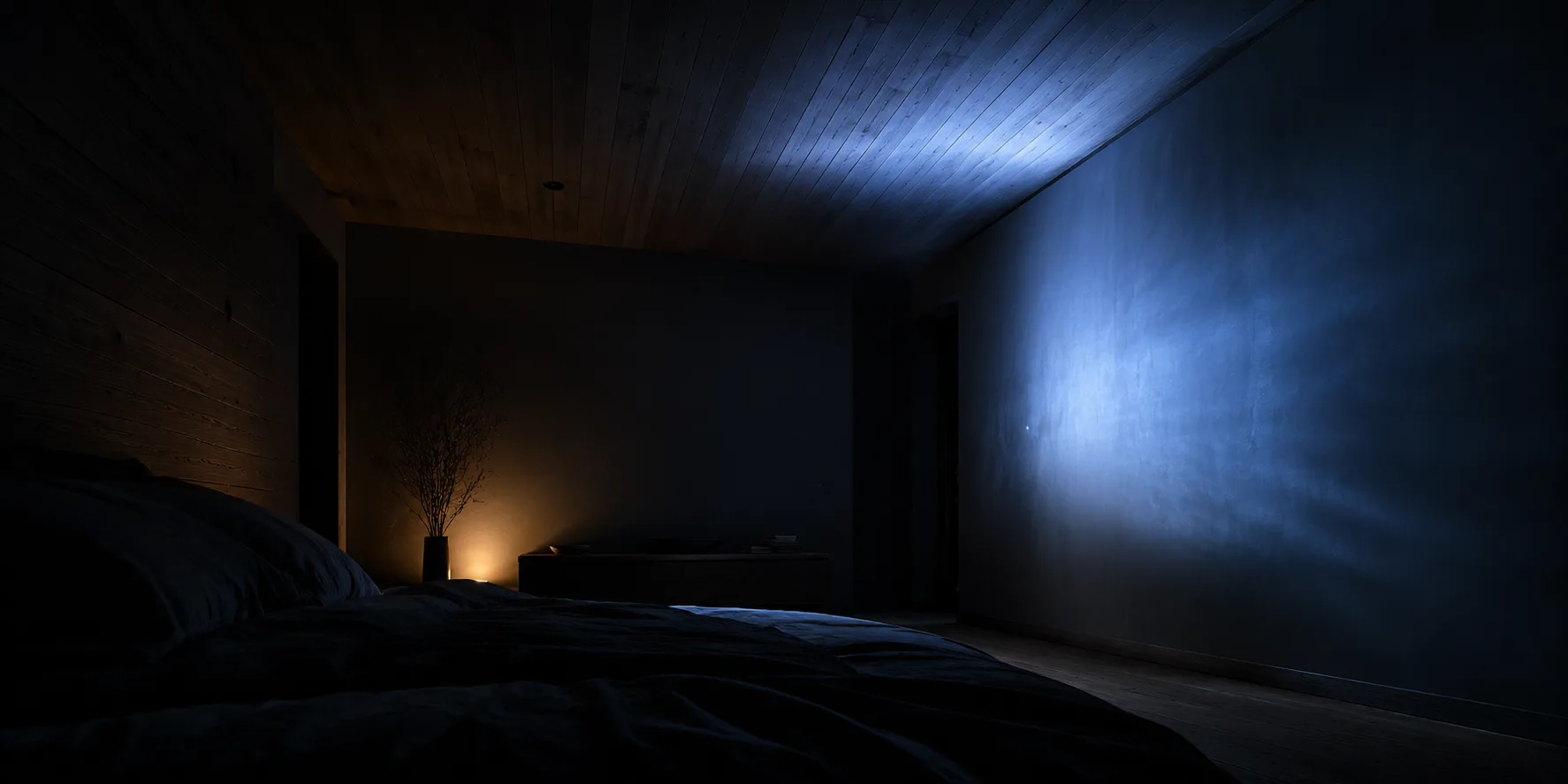
A 2017 paper in the Journal of Pineal Research measured what a normal bedroom does to a healthy adult's overnight melatonin curve. With the lights off and a smartphone in hand, scrolling, for two hours before sleep, melatonin onset was suppressed by an average of 23%. With the bedroom lights on at normal levels, it was suppressed by over 50%. With the bedside lamp dimmed to what most people consider "low," it was suppressed by 19%. Your endocrine system was never asked to consent to any of those numbers. It is taking the hit anyway, every night, in tens of millions of homes.
This is the deep file on light. The biohacking piece touches on morning sun and red bulbs as practical levers. The poisoning overview names artificial light as one of four strands. This file stays inside the strand: what light actually is to the body, what changed in the last twenty years, how the built environment now actively defeats human chronobiology, and what to do about it without becoming the person at the dinner party wearing blue-blocker glasses indoors.
The premise is straightforward. Light is not a comfort variable. It is a primary biological signal, on the same order of importance as food, water, and movement. Modern environments treat it as an aesthetic and convenience choice. The cost of that mismatch is most of what gets diagnosed as anxiety, insomnia, hormonal dysfunction, weight gain, and mood disorder in the adult population.
What light is to a body
Your eye contains a class of cell most people have never heard of, called intrinsically photosensitive retinal ganglion cells, or ipRGCs. They were only described in the early 2000s, which is a useful date to keep in mind: most of the medical infrastructure now telling you light is benign was trained before this cell type was known to exist.
ipRGCs are not for vision. Their job is to read the spectral composition of ambient light and report it directly to the suprachiasmatic nucleus, the master clock in the hypothalamus. The SCN, in turn, runs the timing of nearly every endocrine, metabolic, and immune process in the body. Sleep is the most obvious downstream output. Less obvious: cortisol release, glucose disposal, body temperature, blood pressure, dopamine sensitivity, gut motility, immune surveillance, DNA repair, growth hormone pulses, sex hormone production. All of it is on a clock, and the clock takes its primary input from light hitting the retina.
The ipRGCs are not equally sensitive to all wavelengths. They are tuned, narrowly, to the blue range around 480 nanometers, which is the dominant wavelength in midday outdoor sunlight. That tuning is not arbitrary. It is a 200,000-generation adaptation to a planet with one light source.
This is the part that should make you sit up. Your body, at the cellular level, is reading the time of day off the sky. When the sky is wrong, the body is wrong about the time. When the body is wrong about the time, everything downstream of the time runs in the wrong order.
Two billion years of life on Earth ran on the sun. Forty years of incandescent indoor lighting still emitted a spectrum the body recognized as “evening” or “night,” because filament bulbs are dominated by red and infrared wavelengths. The shift from incandescent to LED, framed as an environmental win, flooded the indoor environment with a spectrum the body had never seen at night, and seen only at midday for the entirety of its evolutionary history.
Your bedroom lamp, your laptop, your TV, your phone, the kitchen ceiling can, the gas station overhang you walked under last night, the streetlight outside your window — all of it is telling your hypothalamus, at the wavelength it is most sensitive to, that it is solar noon.
Why the LED transition was different
It is worth being specific, because most people who lived through it experienced LEDs as “those new bulbs that last forever” and never asked what changed.
Three things changed.
Spectrum. Incandescent bulbs produce light by heating a filament, which means their spectrum is dominated by long wavelengths — red, orange, yellow, and infrared, with very little blue. This is the spectrum the human body evolved to be in at night (fire) and at dawn and dusk (low-angle sun). LEDs produce light by exciting a phosphor coating with a blue diode. The output, even in “warm white” LEDs, contains a large blue spike that does not exist in candle flame or filament light. The spike is most of why “warm” LEDs still feel subtly wrong. They are not, spectrally, warm.
Flicker. Most LEDs flicker. They are driven by alternating current, and unless the driver is high-quality, the bulb pulses on and off at 100 to 120 Hz. You cannot consciously see it. The retina and nervous system can. Flicker exposure has been linked to headaches, eye strain, reduced cognitive performance, and elevated stress markers. Office fluorescents have this problem too, often worse. Children’s bedrooms and classrooms are now full of it. There is no labeling requirement, and the cheap bulbs are the worst.
Coverage. The cost of LEDs dropped by more than 90% in the decade after 2010. That cost drop did not just replace existing bulbs. It expanded coverage. Cities lit more streets, more brightly. Parking lots that used to go dark now stay lit until dawn. Schools, hospitals, gas stations, offices, and homes were retrofitted to brighter average levels because the bulb was cheaper to run. The total light pollution at night, as measured by satellite, has been increasing by about 9.6% per year since 2011, faster than population or economic growth.
The combined effect is that the average modern adult spends a meaningful fraction of their evening hours in light environments that did not exist on Earth before about 2008. The body has no evolutionary preparation for it. The hormone systems take the hit.
The architecture that defeats biology
It is not just bulbs. It is the design of the rooms.
Look at a modern office. Almost no windows that open. Often no windows at all in interior cubicle banks. Overhead fluorescent or LED panels at uniform high-intensity blue-rich light. Same color temperature at 9 a.m. as at 6 p.m. The body cannot tell what time it is from inside the room. Workers in this environment, especially shift workers, show elevated rates of metabolic syndrome, cardiovascular disease, and several cancers — particularly breast and prostate. The International Agency for Research on Cancer has classified night-shift work as a probable human carcinogen since 2007. The mechanism is melatonin disruption. The application to non-shift workers in always-lit offices is the same mechanism with a smaller dose.
Look at a modern school. Same panels. Same uniform blue. Children spending six to eight hours indoors with no morning sun exposure, no spectral cues, no contact with the chronobiological signal their developing brains are calibrating to. The myopia epidemic in school-age children — now affecting over 80% of teenagers in parts of East Asia — has been traced in large part to insufficient outdoor light exposure during development. Not screens. Light. The eye needs the intensity gradient of outdoor sun to grow correctly. Indoor environments are at most 1% of that intensity, even when they feel bright.
Look at a hospital. Patients recovering from surgery, in rooms with no windows or with curtains permanently drawn, under fluorescent panels left on at all hours by night staff. The evidence that recovery times are slower, immune function is worse, and pain is higher in low-daylight hospital rooms has been in the literature for two decades. Almost no hospitals have been redesigned in response.
Look at a smartphone. The single highest-intensity blue-rich light source most adults will encounter at night, held six inches from the face, in a darkened bedroom, for an average of 90 minutes after the bedroom lights have been turned off. The “Night Shift” or “Night Mode” feature on iOS and Android shifts the white point toward warmer tones. It does not, contrary to common belief, eliminate the melatonin-suppressing effect. It reduces it modestly. The screen is still wrong.
This is not a conspiracy. No one in a room agreed to make it this way. It is what happens when a built environment is optimized for cost, brightness, and convenience without anyone in the design loop being responsible for the biology of the humans inside it. The result functions as a control mechanism — not in the sense that someone is pulling a lever, but in the sense that a population that cannot sleep, cannot rest, cannot finish a hormonal cycle, and cannot tell what time it is, is a population that is easier to medicate, easier to keep working, and easier to sell to.
Steelmanning the lighting industry
The strongest version of the industry’s defense is not stupid and deserves to be put plainly.
LEDs use about a fifth of the electricity of incandescent bulbs for the same output. Over their lifespan, the carbon footprint of lighting has been meaningfully reduced. The bulbs last ten times longer, reducing waste. The price drop has made adequate lighting available in parts of the world that did not have it. Streetlight conversion in many cities has improved nighttime safety, real or perceived. There are good people working on tunable LED systems that shift spectrum across the day to better match circadian biology, and those systems are now cheap enough to install in new construction.
These are real benefits. They are also being weighed against a hormonal cost the industry has, for the most part, not been required to measure, and that the public health establishment is two decades behind on. The tradeoff was made by people who were not asked to consent to it and who, in most cases, did not know it was being made.
The frame is not “LEDs are evil.” The frame is “the spectrum and timing of the light in your environment matters as much as the chemistry of the food you eat, and you have been given no signal that this is true.”
What to do, in order of leverage
Start with the night.
Get the overhead lights off after sunset. The single highest-leverage move. Use floor and table lamps. Switch the bulbs in those lamps to incandescent (where still legal) or to high-quality red-spectrum LEDs (Sweetnight, Bon Charge, and others sell them). Even one or two warm sources in the room, with the harsh overheads off, drops blue exposure by an order of magnitude. The room will be dimmer. That is the point.
Blackout your bedroom. Real blackout, not “darker.” Cover the smoke alarm LED with a piece of tape. Turn the clock to the wall. Put a strip of black gaffer tape over the streetlight bleed at the window edge. Aim for cave-dark. If you cannot see your hand in front of your face, you have the target.
Screens off ninety minutes before sleep, or wear blue-blockers. The ninety-minute version is harder and works better. The blue-blocker version is the harm-reduction tier. Get amber or red-orange tinted glasses (Ra Optics, TrueDark — yes, expensive; the $20 Amazon versions are mostly fine for the lens; the build quality is what you pay for). Wear them an hour before bed. The room will look amber. Your brain will register that the sun has set.
Then the morning.
Get sun in your eyes within an hour of waking. Five to ten minutes minimum. Outdoors, not through a window — window glass blocks the wavelengths that matter. Cloudy counts. The intensity even on an overcast day is many times higher than indoor lighting. This is the single most important circadian input you have. It costs nothing.
Get sun on your skin during the day. Midday, when the UVB is present, for short exposures matched to your skin type. Vitamin D production is a part of it. The deeper part is that the body’s daytime cortisol curve and melatonin precursor production are calibrated to skin-level sun exposure, not just retinal exposure. Office workers who never feel daylight on their skin are operating on a partial signal.
Then the in-between.
Replace bulbs in living spaces with low-blue or filament-equivalent options. “2700K warm white” LEDs are better than 5000K. Filament-style LEDs are better still. Incandescent or halogen, where you can still buy them, are best. Avoid daylight-balanced 5000K+ bulbs in any room you spend evening hours in.
Test your space with a flicker app. Open the camera on your phone and point it at the bulb. If you see banding in the viewfinder, the bulb is flickering. There are also dedicated flicker meter apps for testing more precisely. Replace the worst offenders, especially in bedrooms and home offices.
Audit your shift work and your evening obligations. If you work overnight shifts or late evening, the harm is real and the mitigation matters more. Aggressive blue-blocking, supplemental sun during off-cycle, and consistent sleep schedules on days off help. If you can choose not to work nights, choose it.
What this is not
This is not an argument against electric light. Electric light is a major civilizational achievement. The argument is that the version of electric light most people now live under is not the same as the version that was studied for safety in the twentieth century. The spectrum is different, the timing is different, the duration is different, and the saturation of indoor space is different. The body is responding to all four changes at once, and most of the response is being mistaken for personal failure.
This is also not an argument that fixing your light will fix everything. It will not. But it is one of the cheapest, fastest-acting, highest-evidence interventions available to anyone reading this, and it is the lever most people have never touched.
The frame to keep
You are a daylight animal. The room you are in right now is probably lying to your body about the time. Every hour your retina spends in the wrong spectrum is an hour your hormonal architecture is running on bad input. The fact that you cannot feel it does not mean it is not happening. The fact that you have lived this way for a decade does not mean the body has stopped responding. It has been responding the whole time, in the symptoms you have been ignoring.
The fix does not require a guru, a course, or a $5,000 chamber. It requires a switch, a curtain, a pair of glasses, and a willingness to be slightly dim at night.
Sovereignty over your own clock starts at the bulb above your head.
Reach up. Turn it off. Sit in the warm glow of a single lamp for an hour before bed and see what happens to your sleep this week. The body has been waiting for this signal for as long as you have been alive.