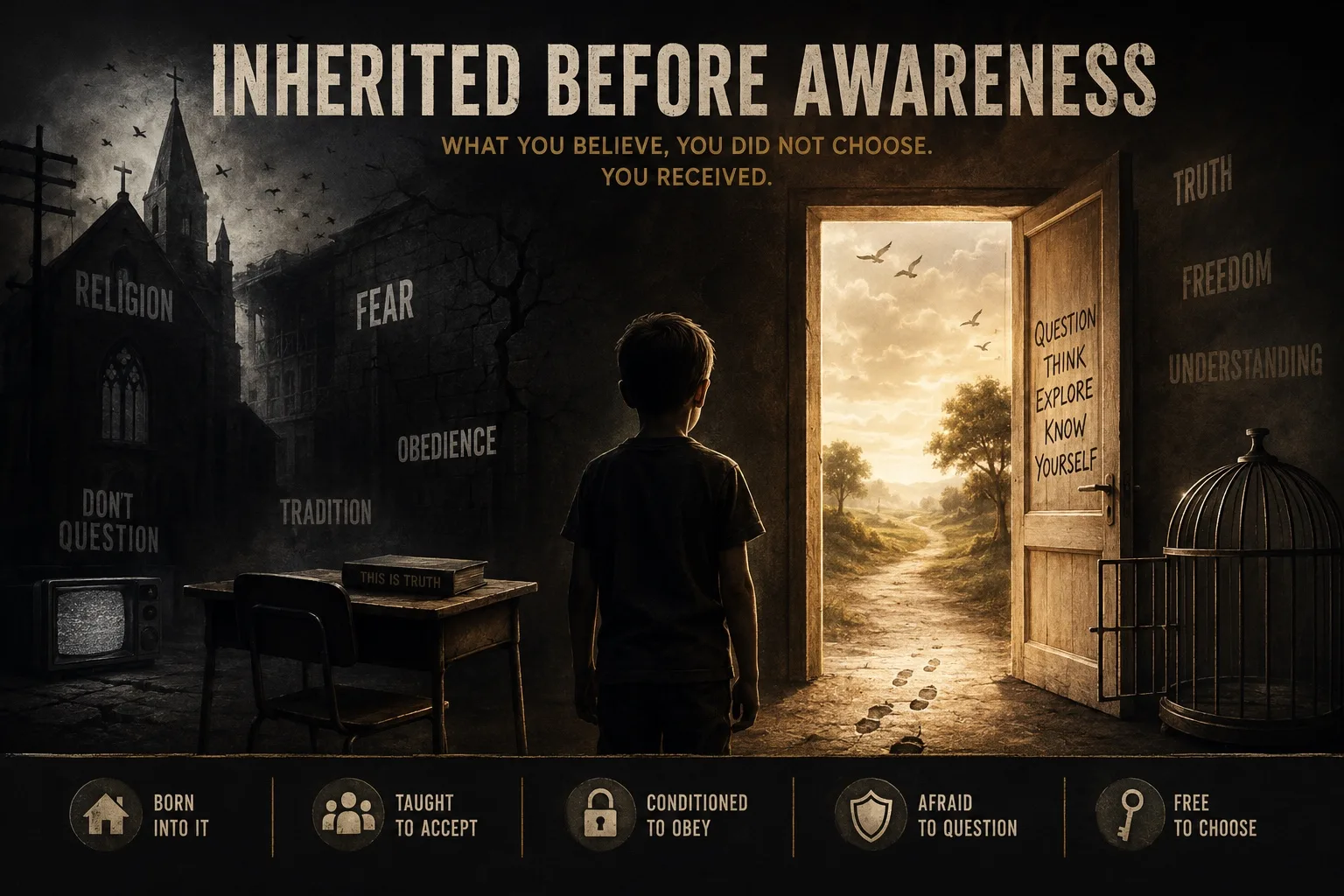
There is a phase of waking up that looks, from the outside, exactly like a personality disorder. You can spot it at any festival, in any comment section, in the eyes of a guy who has just discovered Terence McKenna and needs you to know how the world really works. It is real. It is a stage. Most people stay there, and the ones who do not move through it do so by accident more than design. The work of this piece is to name the arc honestly, so you can navigate it instead of getting flattered by it.
The audience for this is not the person who has never asked a question. It is the person who started asking around eighteen, took a hard left somewhere in their twenties, has been in the conversation for five to fifteen years, and is starting to suspect that some of the people they used to admire are not aging well. If that is you, this piece is for you.
Steelmanning the cynic
The cynic’s position, the one that says “awakening is just an aesthetic for selling things,” is not wrong. It is half-right, and the half it is right about is loud enough to bury the other half.
Look at the supply chain. Awakening, as a market segment, sells courses, retreats, ceremonies, books, ceremonies, oils, ceremonies, more retreats, an Instagram caption tier, an annual conference tier, and eventually a private clinic in Costa Rica. The vocabulary is reliable enough to use as ad copy. Higher self. Shadow work. Inner child. Soul contract. Activation. Frequency. Each of these words started somewhere serious and has been pawned. The people selling the latest version of the language often have a worse track record on attention, sobriety, and human relationships than the average accountant.
The cynic notices this and concludes that the whole project is fake. That conclusion is too tidy. The fact that something can be sold badly does not mean the underlying thing is not real. The supply chain around chiropractic is full of cranks; spinal alignment is not therefore made up. The supply chain around psychedelics is full of opportunists; ego dissolution is not therefore made up. The supply chain around awakening is full of grift; the underlying shift in perception is not therefore made up.
You can hold both. You should.
The arc, honestly
There is a recognizable sequence. It is not a ladder, it is not linear in any clean sense, and people loop back through the early stages many times. But the shape is consistent enough across traditions, across centuries, that it is worth describing in plain language.
Phase one: disillusionment
Something cracks. The crack might be a death, a substance, a relationship ending, a year of bad sleep, a documentary, a piece of news that finally lands, a meditation retreat, a long walk that did not stop being long. The content does not matter. The effect does. You stop being able to inhabit the story you used to live inside as if it were obvious. The cubicle stops being neutral. The mortgage stops being the point. The plot of your own life shows itself as a plot.
This phase is uncomfortable and ungrateful. The people around you, who were in the same story, do not understand what happened. You probably cannot explain it. There is no good vocabulary for “I am not on board with my own life anymore,” especially not at brunch.
A lot of people end this phase by re-attaching to the old story with extra force. A new car. A second baby. A promotion. The crack closes. Nothing further happens. That is a legitimate outcome, and it is what most people choose, because the next phase is harder.
Phase two: seeing patterns
The crack stays open and you start looking. This is the phase the literature calls “the via negativa,” the road of subtraction, but in practice it is more like a flashlight in an attic. The conditioning becomes visible. The way the food was advertised. The way the school was structured. The way the news framed the question so that the answer was already inside it. The way your parents loved you and the way they did not. The way your industry is built. The patterns are real and the seeing is, mostly, accurate.
This phase is exhilarating. For the first time in your adult life, you feel like you are looking at the actual room instead of the wallpaper. You read voraciously. You change your diet. You delete an app. You have a long conversation with a friend who has been through this and finally feels like the only sane person in your life.
This is where the danger starts.
Phase three: over-correction
The flashlight, having found one thing, starts finding it everywhere. Every news headline is a psyop. Every product is poison. Every social interaction is a power dynamic. Every coincidence is a synchronicity. The pattern recognition that was sharp in phase two becomes maximalist in phase three, and the world starts to look like a single coordinated conspiracy aimed at the awakened class, which is to say, you.
This is the phase where you alienate your family. Not because they are wrong about everything, but because you are now wrong about everything in the other direction. The contempt for the “sleepwalkers” gets thick. The vocabulary gets dense. The opinions get loud and confident on subjects you were entirely unaware of six months ago.
Most people get stuck here. Some get stuck for years. Some get stuck for the rest of their lives. The phase is not, in itself, a failure. Every serious tradition describes a period where the student becomes insufferable. The failure is staying there and calling it the destination.
The tell is contempt. If the engine of your current worldview is feeling smarter than other people, you are not awake. You are in a flattering hallucination, sold to you in part by the same supply chain we discussed above, which has a specific commercial interest in keeping you in phase three. The phase-three customer is a great customer. They buy the course, the supplement, the retreat, the next course. The phase-five customer does not need anything.
Phase four: identity inflation
A subset of phase three, severe enough to deserve its own label. This is where the awakening becomes a personality. The clothing changes. The vocabulary changes. The social media presence becomes a teaching role. There is a sense that you have been given access to something the masses do not have, and the natural next step is to package it. Often, at this stage, the practice itself quietly stops, because being a person who has awakened is much easier than continuing to do the work that would actually deepen it.
The traditions call this “spiritual ego” or “the golden chain” and they have warned about it for two thousand years for a reason. It is a stable trap. The trap closes when the inflation gets reinforced by an audience that wants what you appear to have, and you start being the version of you that they need. From the inside, this feels like service. From the outside, it is a cult of one, and you are the only member.
This phase is the one to be the most ruthless about in yourself. The work is not the costume. The work is the willingness to be wrong, in private, where no one is watching.
Phase five: integration
If you are lucky, or persistent, or you have lost enough to be humbled, you start to come down. The world you found in phase two is still there. The patterns are still real. But the urgency softens, and so does the certainty. You stop needing the people around you to see what you see. You stop needing the worldview to be coherent. You start, slowly, to notice that the people who actually changed your life were not the loudest awakened ones. They were the quiet ones, doing the thing, not talking about it.
The vocabulary shrinks. You stop saying “frequency.” You start being able to have a conversation with your mother again. You re-engage with the world, but the engagement is different. You can take a job without the job swallowing you. You can take a drink without the drink replacing you. You can scroll without disappearing.
This phase is, frankly, less photogenic. It does not generate content. There is no costume. People in phase three will, occasionally, accuse you of having gone back to sleep, because the surface looks the same as the unawake life. It is not the same. It is what the work looks like when it is done.
Phase six: quiet sovereignty
The end of the public arc, if there is one. You stop talking about awakening because the word has stopped being useful. You stop seeking teachers because you can recognize teaching in ordinary places. You stop performing the inner life and start living it. The practice continues, often more rigorously than before, but it is no longer load-bearing for your identity. You do it because the body and the mind need it, the way other people brush their teeth.
The traditions describe this phase in many ways. “Ordinary mind.” “Chop wood, carry water.” “After ecstasy, the laundry.” The shared point is that the arc does not lead somewhere exotic. It leads back to a regular life, lived with the attention turned on.
This is not the destination most people are sold. It is the destination most of the lineage agrees on.
The middle-phase trap, in detail
Because most readers of this piece are either in phase three, in phase four, or have a friend who is, it is worth being specific about the trap.
The trap has three reinforcers.
The first is content. The phase three worldview is endlessly content-generative. Every news cycle proves the framework. Every dinner conversation provides material. The mind in this phase is rarely bored, which is part of why it is hard to leave: boredom is the doorway to the next phase and you have been told boredom is a problem to be solved.
The second is community. Once you have signaled the worldview publicly, your social graph rearranges around it. The old friends drift. The new friends are reading the same things. Leaving the worldview now costs you the community, which is no small thing. Many people stay in phase three not because they still believe everything but because the exit is socially expensive.
The third is commerce. There is an entire economy that makes its money inside phase three. It does not benefit anyone in that economy for you to move into phase five, where you stop buying. The algorithms know what to feed you. The substacks know what to write. The ceremony facilitators know what to charge. Inflation is good for business.
The way out is not arguing yourself out of phase three. You cannot. The way out is the same way out as every other trap of identity: enough quiet, enough humility, enough actual practice, and a small number of older people in your life who have done the thing and will not let you stay in the costume.
What to do, wherever you are
If you suspect you are in phase one, do not move yet. Do not pick a new identity. Sit with the discomfort and write it down. The crack is information. It is also fragile.
If you are in phase two, read deeply but slowly. Pick one tradition or one frame and go to the bottom of it before you collect another. Most of what looks like wisdom in this phase is breadth without depth. The depth is the medicine.
If you are in phase three or four, the work is contraction. Talk less. Post less. Sit more. Spend time with people who are not in your worldview and who you respect. Notice every time you feel contempt and write it down without justifying it. Reintroduce activities that do not signal your worldview: a sport, a craft, a normal book club. The aim is not to abandon what you have learned. The aim is to find out who you are without the costume.
If you are in phase five or six, the work is fidelity. Do not coast. The fact that you stopped performing does not mean you are done. The discipline gets quieter, not lighter. Find a teacher who is older than you, in whatever lineage you trust, and check in. Find one or two peers who will tell you the truth when you start slipping.
The frame to keep
Awakening is real. The supply chain around it is mostly fake. Most people who claim to be done are still mid-arc. Most people who are actually further along are not interested in telling you about it.
The point of the work is not to become a different person. It is to become the person you actually are, with the wallpaper down and the lights on. That person is, often, less exotic than the awakened-class costume suggests and considerably more useful to the people around them.
If you are five years in and the costume is heavy, take it off. Nobody good will notice. The ones who do were never the audience.