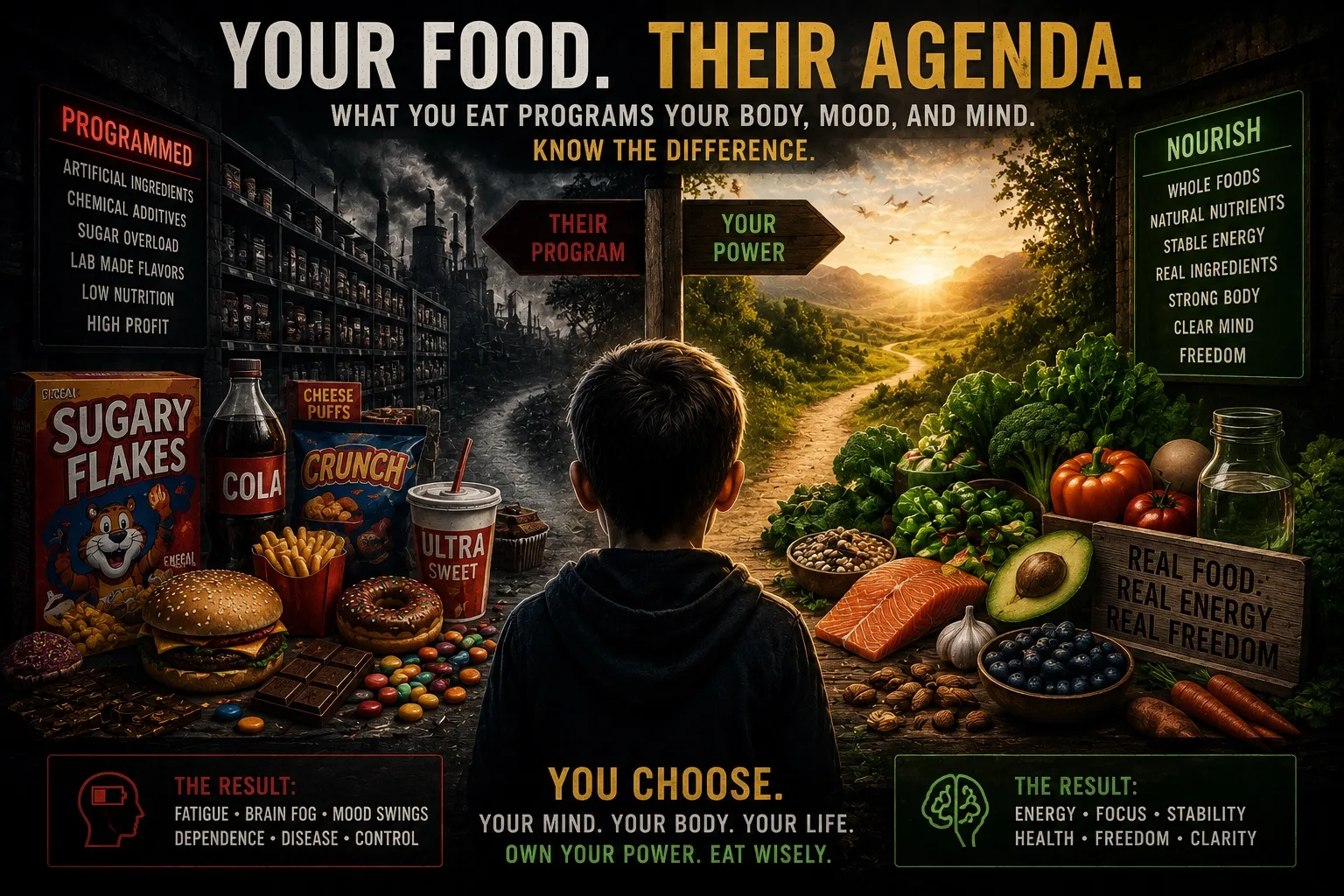
Microplastics in placentas. Glyphosate in breast milk. Lead in baby food. LED light at 2 a.m. These are not four scandals. They are one story told in four chemistries: a century of "this is fine" that the human body is now sending back marked Return to Sender.
The instinct, when you first see the receipts stacked together, is to call it a conspiracy. It isn’t. A conspiracy needs a room of people agreeing to a plan. What we have is something simpler and worse: a regulatory architecture that approves substances individually, by the dose, in the lab, on the timeline of a quarterly report, and then turns away while they accumulate together, chronically, in the wild, across generations. The body is paying interest on debt nobody on the issuing side has to carry.
This file is the overview. The other files in the Vault go deep on each strand. Read this one to see why they belong on the same table.
Steelmanning the official position
It is worth being precise about what regulators actually claim, because the strongest version of their argument is not stupid. The EPA, FDA, and EFSA argue that they evaluate substances against the best available toxicology, set “tolerable” exposure limits with safety factors built in, and update those limits when new evidence warrants. Most acutely toxic compounds have, in fact, been removed or restricted: leaded gasoline, DDT for agricultural use, asbestos in most building materials, BPA in baby bottles. The mainstream defense is not “everything is safe.” It is “we have managed acute harm, and chronic low-dose exposure is below thresholds we can statistically link to outcomes.”
That is a defensible position right up until you ask three questions it cannot answer. What happens when a person is exposed to forty “below-threshold” compounds at once. What happens when the relevant outcome is multi-generational, like a developmental shift in your grandchild’s hormone profile. And what happens when the regulator’s data comes primarily from the manufacturer.
The official position holds in the laboratory. It breaks in the body.
The four strands
Plastic that doesn’t stay outside. Microplastics and their smaller siblings, nanoplastics, have been documented in human blood, lung tissue, placenta, testes, and most recently the brain at concentrations rising year over year. The mechanism is not exotic: plastic sheds. Bottled water, polyester clothing, food packaging warmed in a microwave, the dust in your living room. The dose is small. The exposure is every day. The half-life inside you is, for the smaller particles, effectively forever.
An herbicide in the food chain. Glyphosate, the active ingredient in Roundup, is the most widely applied agricultural chemical on Earth. The WHO’s IARC classified it as a probable human carcinogen in 2015. The EPA disagreed. Bayer, which acquired Monsanto and inherited the litigation, has paid out over $11 billion in settlements for cases it continues to insist have no merit. The chemical shows up in oat-based cereals, in human urine, and in the breast milk of pregnant women in industrial countries. Whether you eat organic or not, your body’s burden is shared with the watershed.
Metals where they don’t belong. A 2021 Congressional report found that internal testing by the largest baby food manufacturers showed arsenic, lead, cadmium, and mercury in their products at levels the companies themselves recognized as harmful. They sold the products anyway. The FDA, asked to set binding limits, has spent the four years since publishing draft guidance and inviting comment. Lead in tap water remains an open file in tens of thousands of American homes. Cadmium in cacao, mercury in tuna, aluminum in antiperspirant and vaccine adjuvants. Each one survives its own risk assessment. None of them are assessed against the others.
Light that never lets the body finish its work. Your endocrine system was built around a sun. The pineal gland reads photons and releases melatonin not just to make you sleepy but to repair DNA, regulate immune function, and coordinate the body’s overnight maintenance schedule. Blue-spectrum light at night suppresses melatonin by up to 50% at intensities common in a modern bedroom. The shift from incandescent to LED, framed as an environmental win, has flooded the indoor environment with a spectrum the human body had no evolutionary preparation for and no off switch from. The cost is not “tiredness.” The cost is a slow withdrawal of a hormone that, in the dark, is supposed to be cleaning up after you.
Why the official frame keeps missing it
Four observations, taken from inside the regulatory literature itself.
The first is that toxicology is tested one molecule at a time. Real bodies meet hundreds simultaneously. The interaction effects, what the literature calls the “cocktail effect,” are acknowledged in EU policy documents and almost entirely absent from how individual approvals are made.
The second is the dose-response curve assumption. Classical toxicology assumes that more of a substance produces more harm in a smooth line. Endocrine disruptors, a category that includes many plastics-derived compounds, break this rule. At very low doses, in fetuses, they can produce effects that disappear at higher doses and reappear in the next generation. The standard model literally cannot see them.
The third is regulatory capture. The people who write the safety studies, the people who interpret them, and the people who later move to industry consulting roles are often the same people. The FDA’s revolving door is not a slogan, it is documented. This does not mean every individual is corrupt. It means the system rewards a particular kind of caution, the kind that protects market access, and punishes a different kind, the kind that protects the body.
The fourth is timeline. A regulator’s career is twenty years. A child’s developmental window is nine months. A cancer’s latency is thirty. The institution and the harm are not running on the same clock, and the institution sets the agenda.
What you can actually do
You will not detox your way out of an industrial chemistry problem with a green juice. You can, however, lower your exposure and raise your body’s capacity to clear what gets in. The goal is not purity. The goal is load reduction and resilience.
- Filter your water. A reverse-osmosis system or a high-quality carbon block (NSF/ANSI 53 and 401) handles most of the contaminant classes above. Bottled water is not the answer; the plastic is part of the problem.
- Eat organic where you can prioritize the Dirty Dozen. It is not a moral position. It is glyphosate avoidance and a vote against the supply chain that requires it.
- Stop microwaving in plastic. Stop drinking hot liquid out of plastic-lined cups. Stop wearing synthetic fibers next to your skin overnight. None of these are inconvenient once they become habit.
- Test what you can. A hair tissue mineral analysis, a urine porphyrins panel, a Quicksilver mercury test. You cannot manage what you do not measure, and the doctor’s standard panel is not looking.
- Honor the dark. Block your bedroom windows. Use red-spectrum bulbs after sunset. Get morning sunlight in your eyes within an hour of waking. This costs nothing and pays in sleep architecture, mood, and recovery.
- Move the lymphatic system. Sweat in a sauna if you have one, walk if you don’t, dry-brush, breathe deep. The body’s drainage was designed for an active animal, not a sedentary one.
- Track your own data. Sleep, mood, gut, energy. The body is the only instrument calibrated to your particular load.
The frame to keep
This is not a story about villains, though there are villains in it. It is a story about a chemistry experiment run on a species without informed consent, by an institutional architecture that is structurally incapable of seeing what it is doing.
Seeing it is not the same as fixing it. But you cannot reduce a load you have not named.
The other files in the Vault take each strand to the bottom. Start with whichever one is touching your life hardest right now. The pattern is what matters. Once you see it, you cannot unsee it, and that is the first sovereign act.